What Can I Do with Kelvin?
This course is for anyone evaluating or getting started with Kelvin.
By the end, you will have concrete ideas for how Kelvin can create value in your operation — whether you are on the ground, in the office, or in the boardroom.
Who Is This For?
Different people see different value in Kelvin. Jump to what matters most to you, or read through to see the full picture.
| If you are... | Start with... |
|---|---|
| Operations / Field | Smarter Control, Human in the Middle |
| Management | Scale What Works, Connect the Enterprise |
| Executives / Investors | The ROI Picture |
| Developers | Smarter Control, Connect the Enterprise |
Smarter Control
Your PLCs, DCS, and RTUs already control your assets. They do what they are told. Kelvin does not replace them — it makes them smarter.
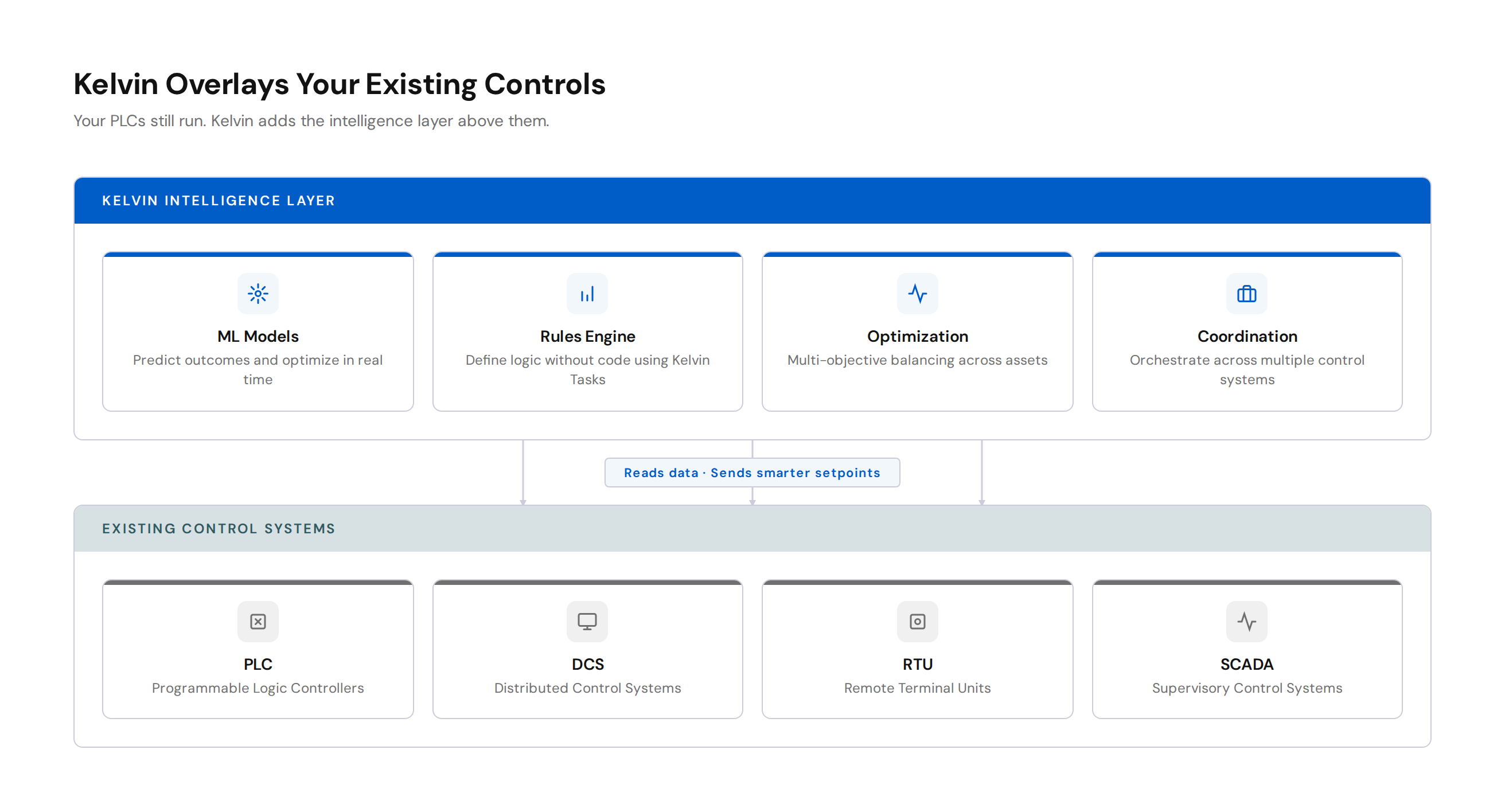
Kelvin sits above your existing control systems and adds a layer of intelligence. This can be rules you define, machine learning models, physics-based simulations, or any combination.
Example — Industrial Dryers
A manufacturing facility runs industrial rotating dryers. The existing controls manage moisture output, but keeping it stable requires constant manual adjustment by operators.
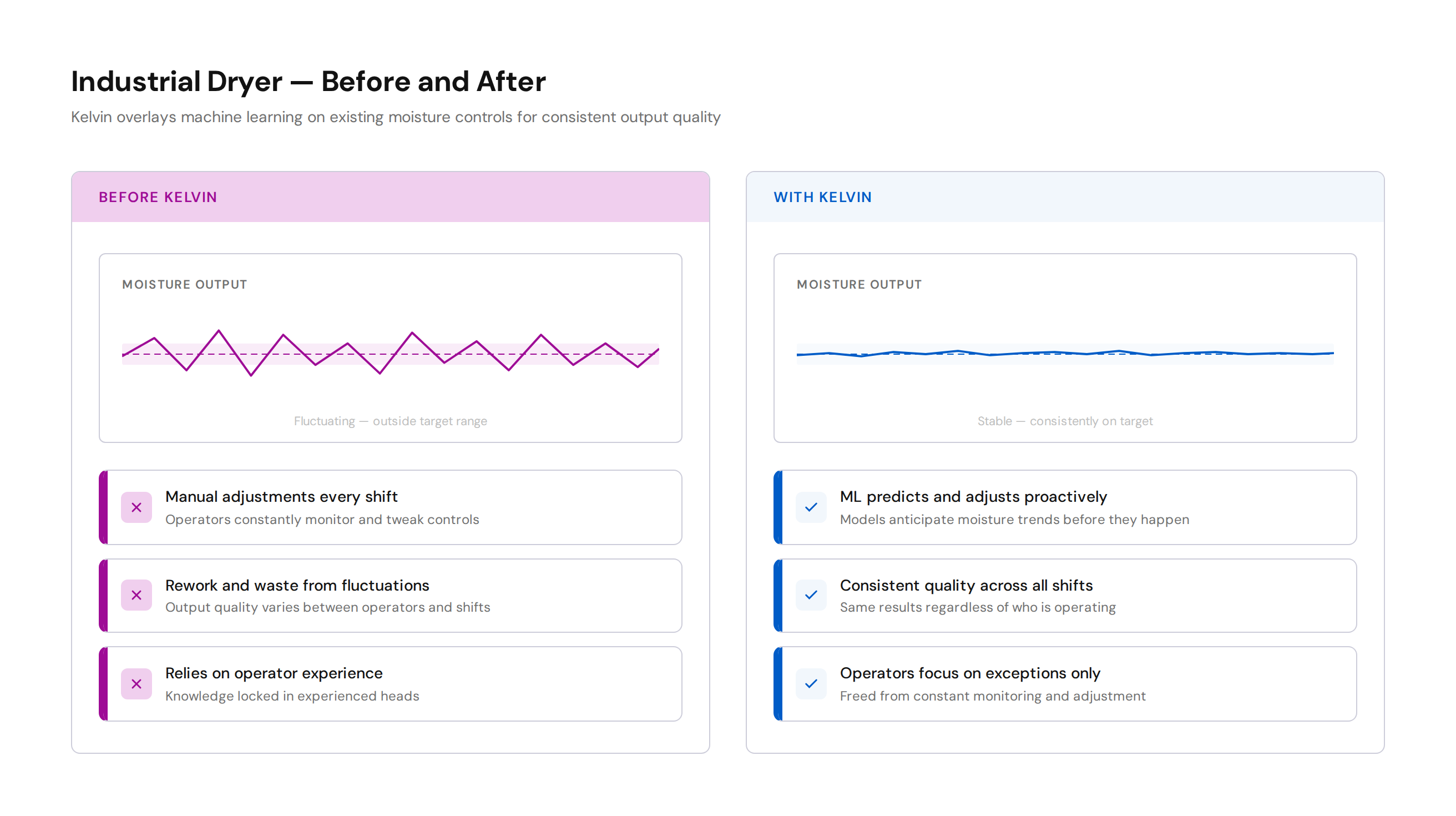
Before Kelvin:
- Operators manually monitor and adjust controls throughout the shift
- Output moisture quality fluctuates, requiring rework or waste
- Experienced operators get better results — but that knowledge does not scale
With Kelvin:
- A machine learning model predicts moisture trends before they happen
- Kelvin automatically adjusts setpoints through the existing control system
- Operators are freed from constant monitoring and can focus on exceptions
- Output quality becomes consistent across all shifts, all operators
Key Insight
Kelvin does not ask you to rip out what you already have. It overlays intelligence on top of your existing infrastructure.
Example — Well Optimization
An oil and gas operation manages hundreds of beam pump and PCP wells. Each well has its own characteristics and operating conditions.
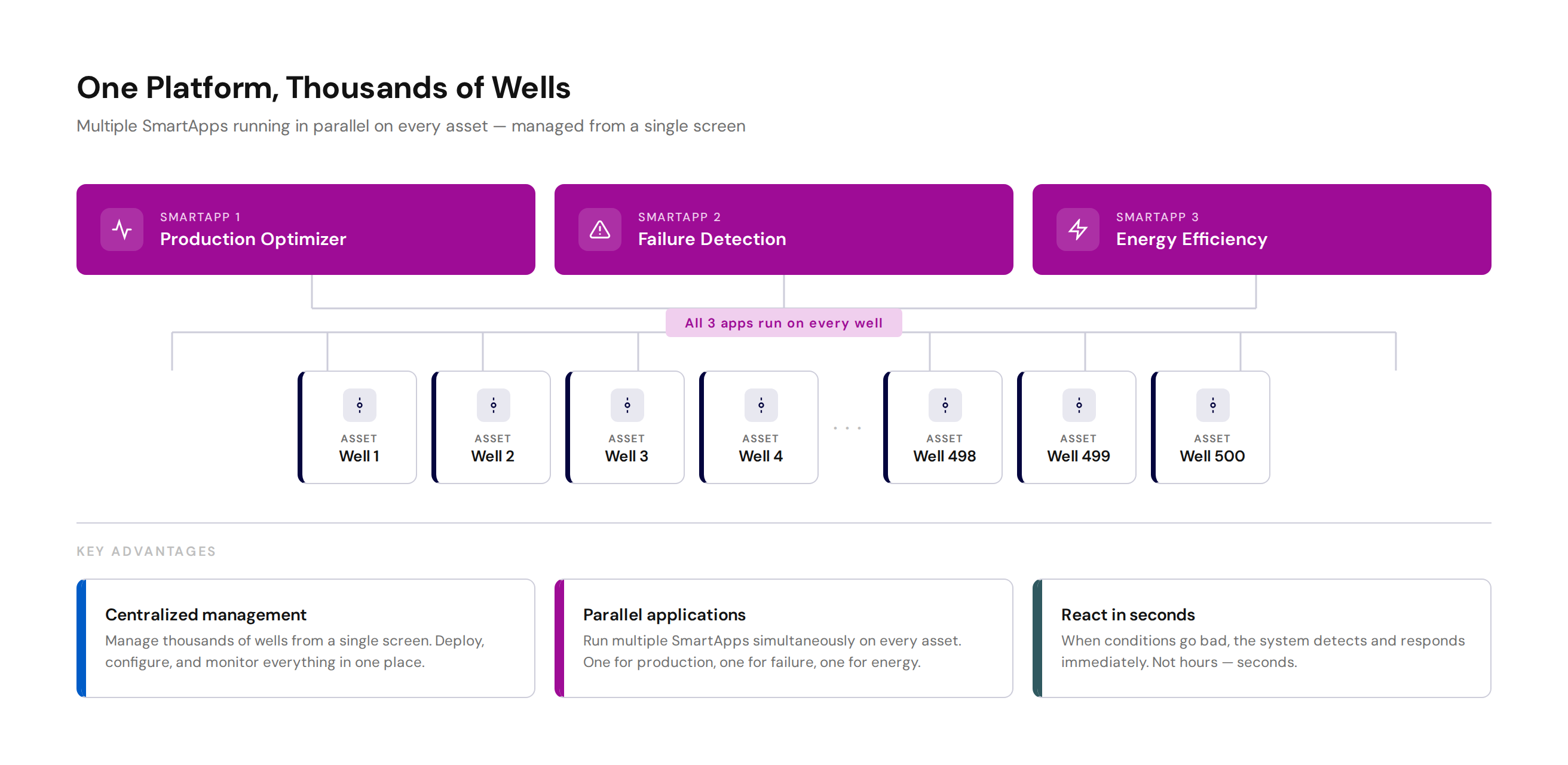
Before Kelvin:
- Engineers manually tune each well — a slow, one-at-a-time process
- Reacting to problems is slow because there are too many wells to watch
- Knowledge lives in the heads of experienced engineers
With Kelvin:
- ML models optimize each well individually, in real time
- Multiple SmartApps run in parallel — one for production optimization, another for failure detection, another for energy efficiency
- Engineers manage thousands of wells from a single screen
- When conditions go bad, the system reacts in seconds, not hours
Human in the Middle
Not everything should be fully automated. Some decisions need a human. Kelvin is built for this.
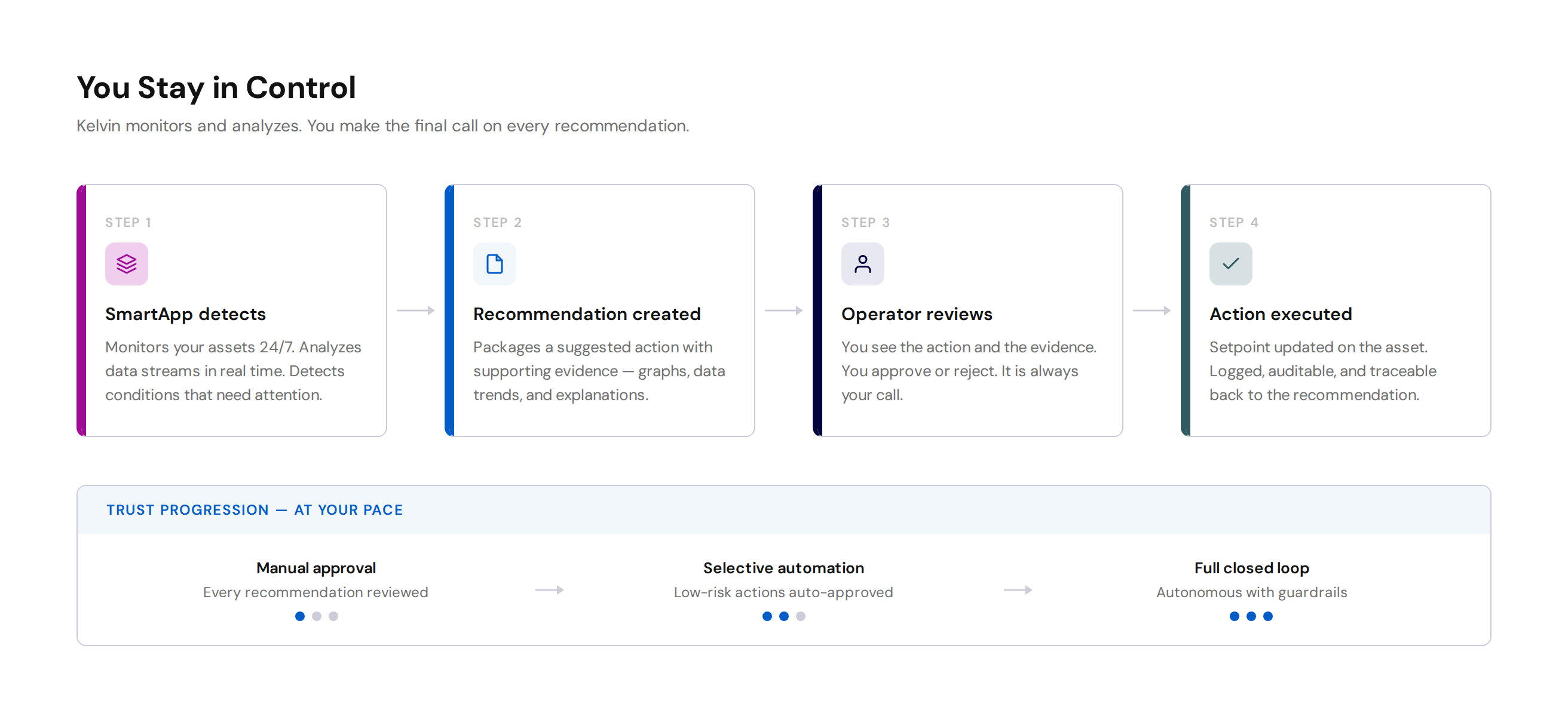
Every recommendation Kelvin generates can be configured to require manual approval before any action is taken. Operations teams stay in control.
Success
Even when actions are set to run automatically, guardrails prevent clearly wrong values from being written to assets, helping protect asset stability.
What a recommendation looks like:
- A clear suggested action — "Reduce choke setpoint to 70%"
- Supporting evidence — graphs, data trends, explanations
- One-click approve or reject
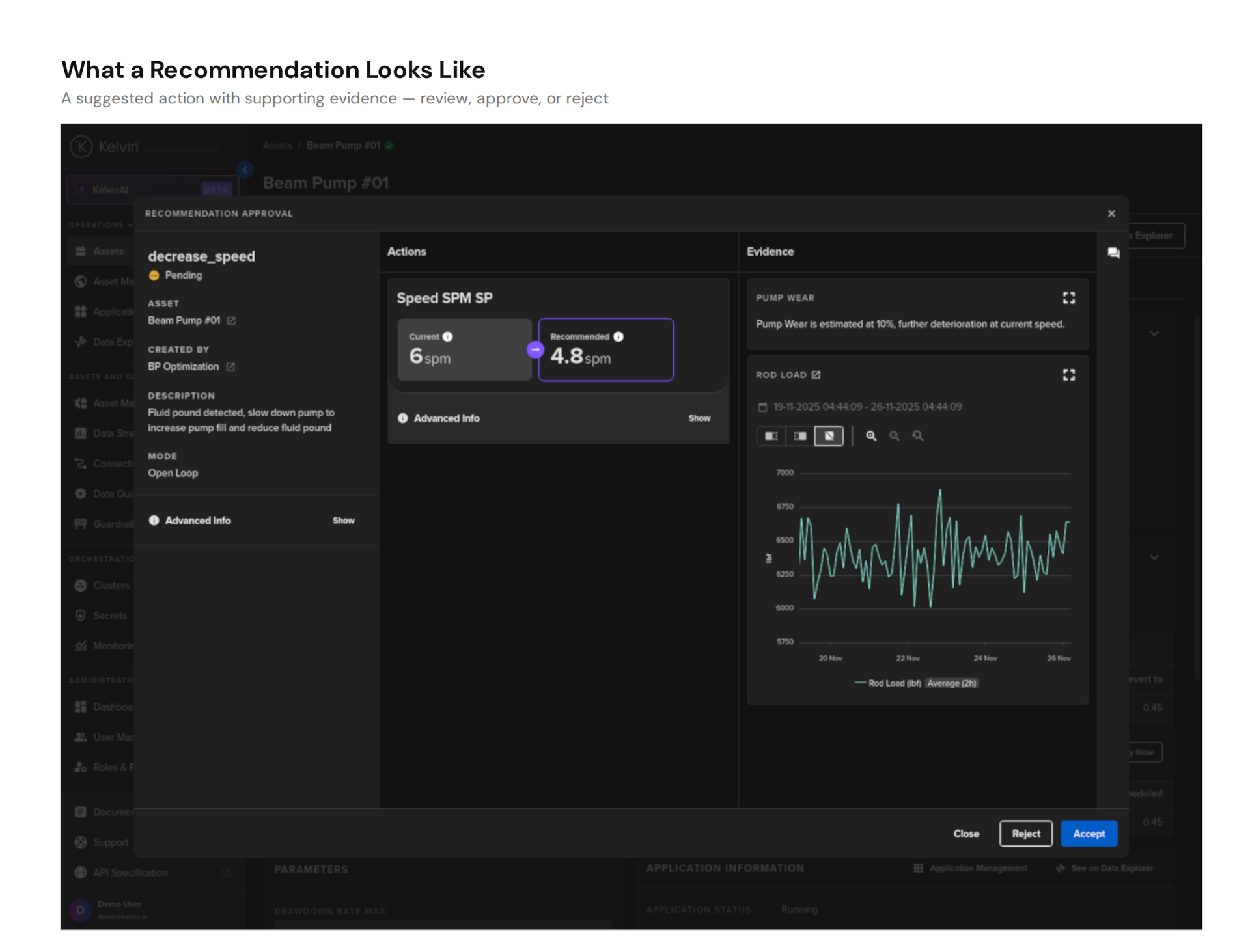
Why this matters for operations teams:
You are not being replaced. You are being given better tools. Kelvin handles the monitoring and analysis across hundreds or thousands of assets. You make the final call.
As trust builds, workflows can move from manual approval to fully automatic — at your pace, on your terms.
For Operations
Think of Kelvin as your most diligent colleague — one who watches every asset, never sleeps, and always shows their working before asking you to act.
Scale What Works
One of Kelvin's most powerful capabilities is what happens after you solve a problem once.
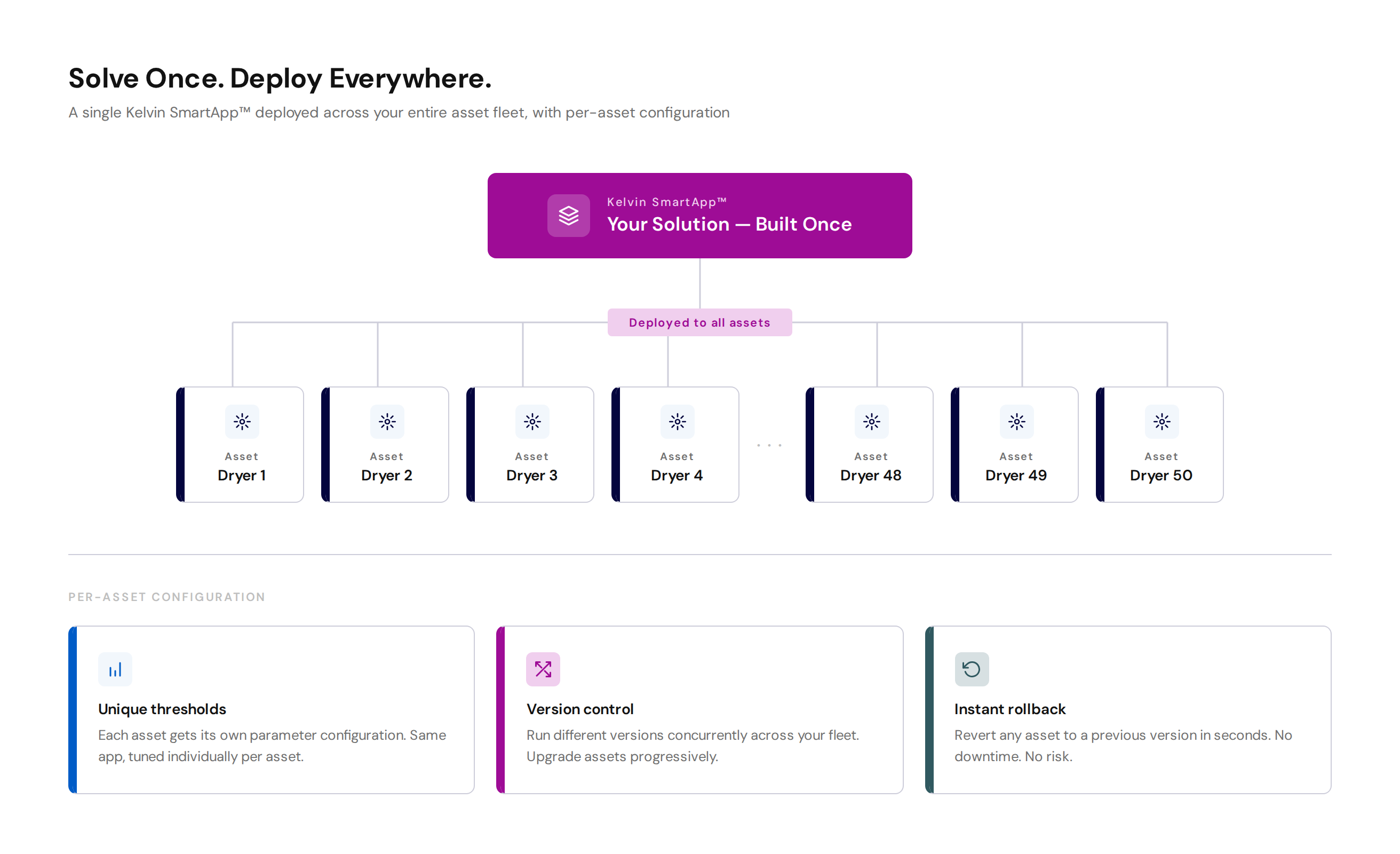
A SmartApp built for one asset can be deployed to thousands with a few clicks. No reinstallation. No reconfiguration per site. The platform handles the distribution, monitoring, and management.
What This Looks Like in Practice
- One SmartApp, many assets — Deploy the same optimization logic to every well, every dryer, every compressor in your fleet
- Parallel applications — Run multiple SmartApps on the same asset simultaneously. One optimizes production, another monitors health, another manages energy
- Per-asset tuning — Each asset gets its own parameter configuration. One dryer might need different thresholds than another. Kelvin handles this without needing a separate application
- Version management — Roll out updates progressively. Test on a few assets, then expand. Roll back instantly if needed
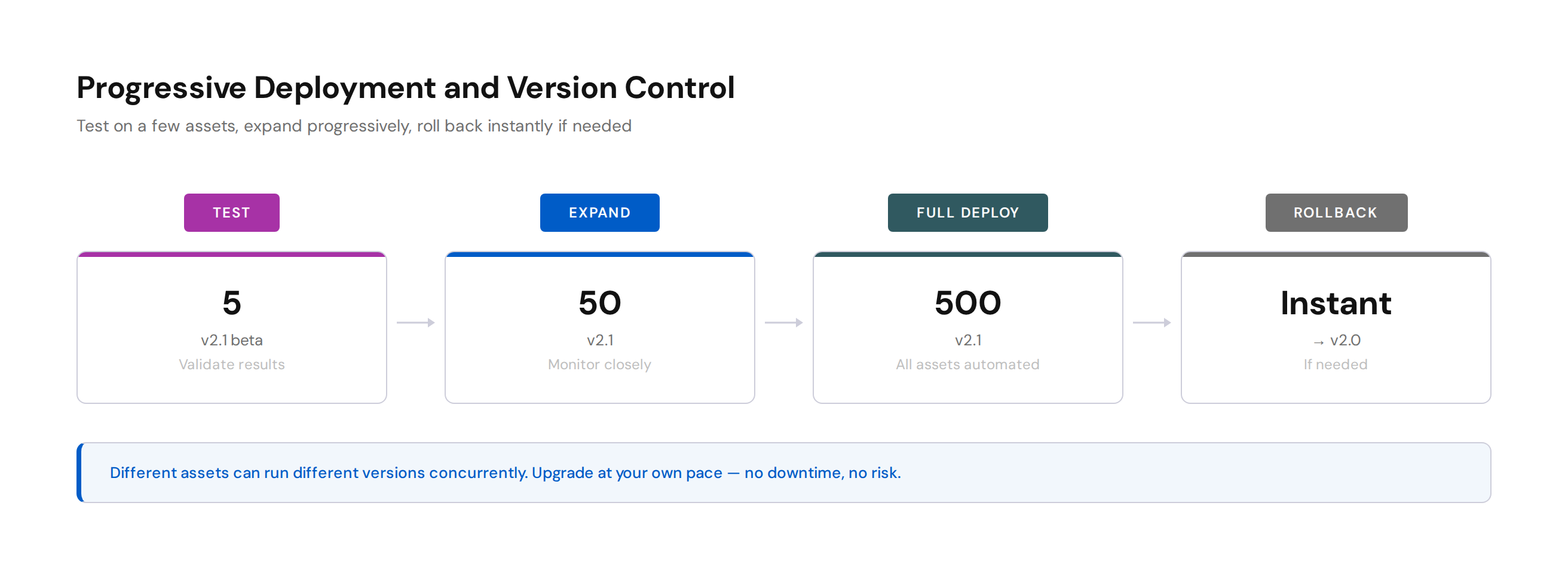
Key Insight
The cost of solving a problem once is high. The cost of applying that solution to every asset in your operation should be close to zero. That is what Kelvin enables.
Connect the Enterprise
Most operations run on siloed systems. Your SCADA does not talk to your ERP. Your maintenance system does not know what your process data is showing. Kelvin connects them.
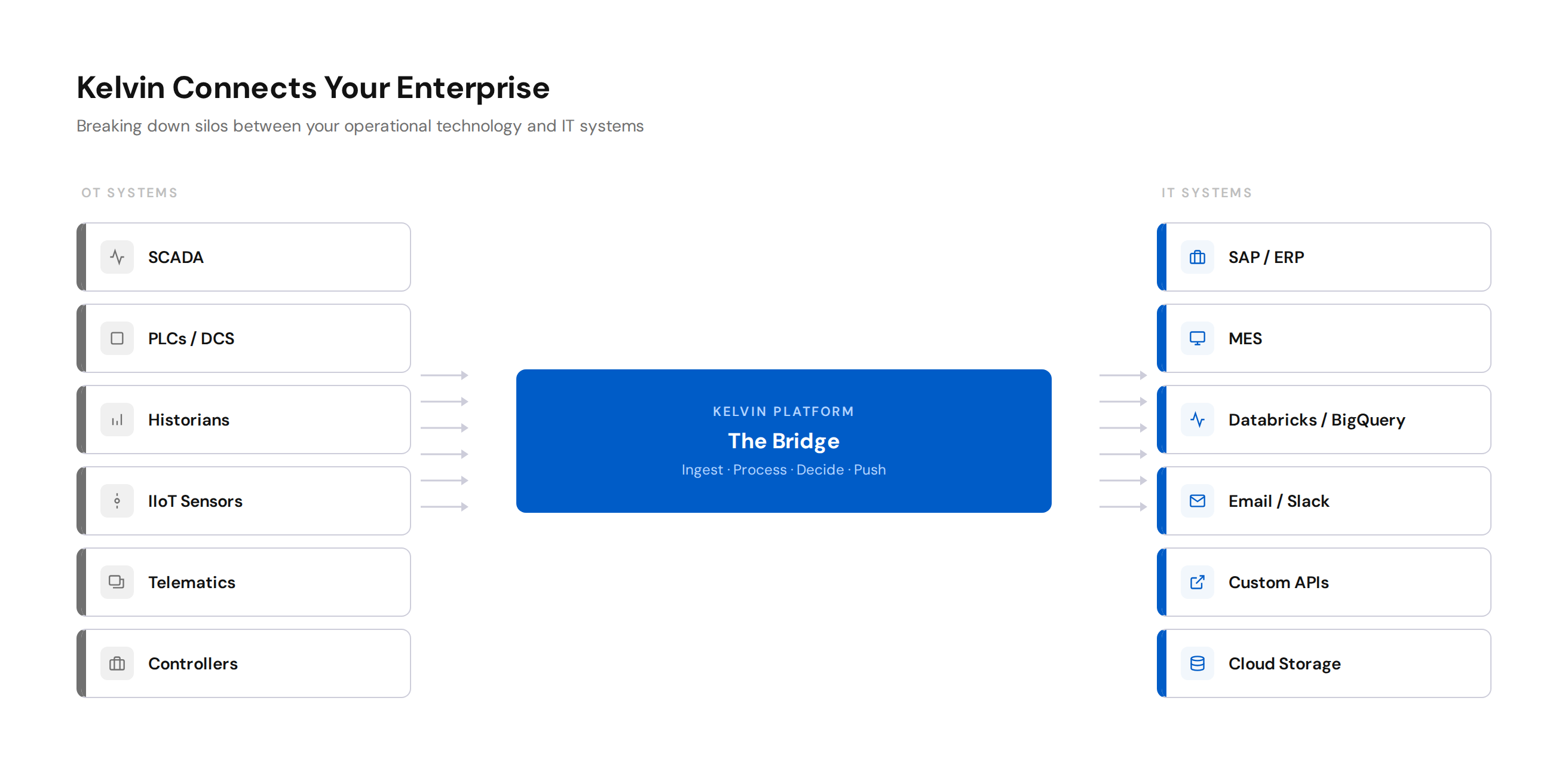
Equipment and Fleet Tracking
Consider a fleet operation managing cement trucks, trailers, crews, and materials across multiple sites.
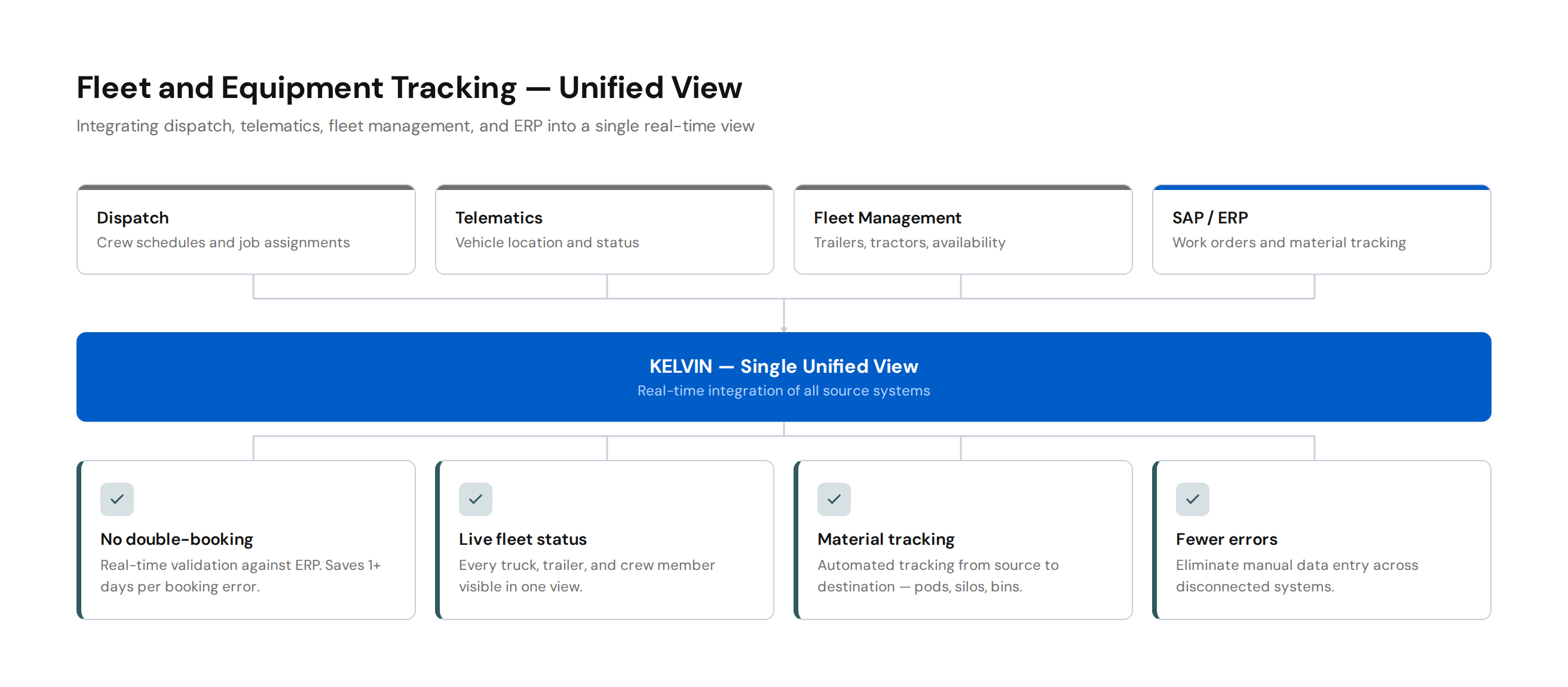
The problem:
- Crew, trailer, and tractor tracking lives in separate systems
- Double-booking equipment in the ERP causes errors that take a day or more to resolve
- Material tracking across pods, silos, and bins is manual and error-prone
With Kelvin:
- A single SmartApp integrates data from dispatch, telematics, and fleet management systems
- Real-time status of every truck, trailer, and crew member in one view
- Direct integration with SAP or your ERP eliminates double-booking and manual data entry errors
- Material movements are tracked automatically from source to destination
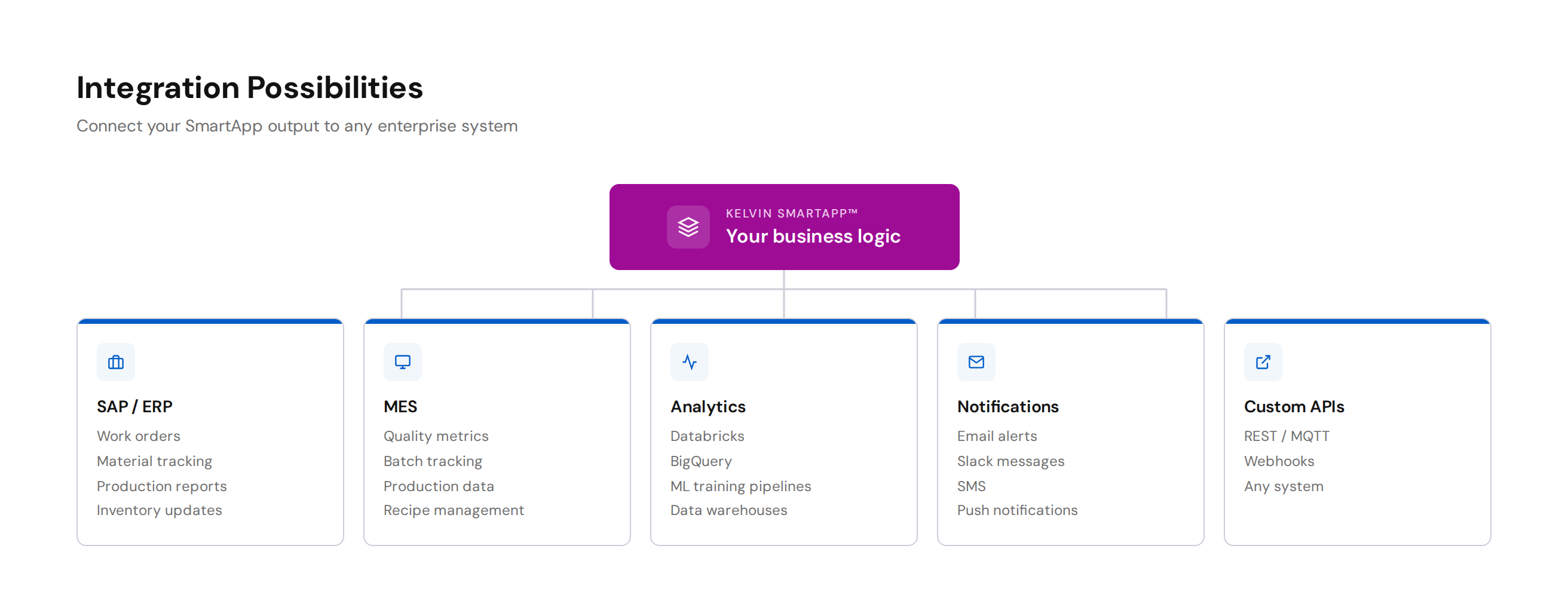
Integration Possibilities
Kelvin connects your operational data to the systems that need it:
| System | What Kelvin Enables |
|---|---|
| ERP / SAP | Automated work orders, material tracking, production reporting |
| MES | Real-time production data, quality metrics, batch tracking |
| Databricks / BigQuery | Feed operational data to analytics and ML training pipelines |
| Email / Slack | Automated alerts and notifications to the right people |
| Custom APIs | Connect to any system with a REST or MQTT interface |
Key Insight
The most valuable data in your operation is often trapped in systems that do not talk to each other. Kelvin is the bridge.
Data You Can Trust
Automation is only as good as the data behind it. Bad data leads to bad decisions. Kelvin has built-in protections for this.
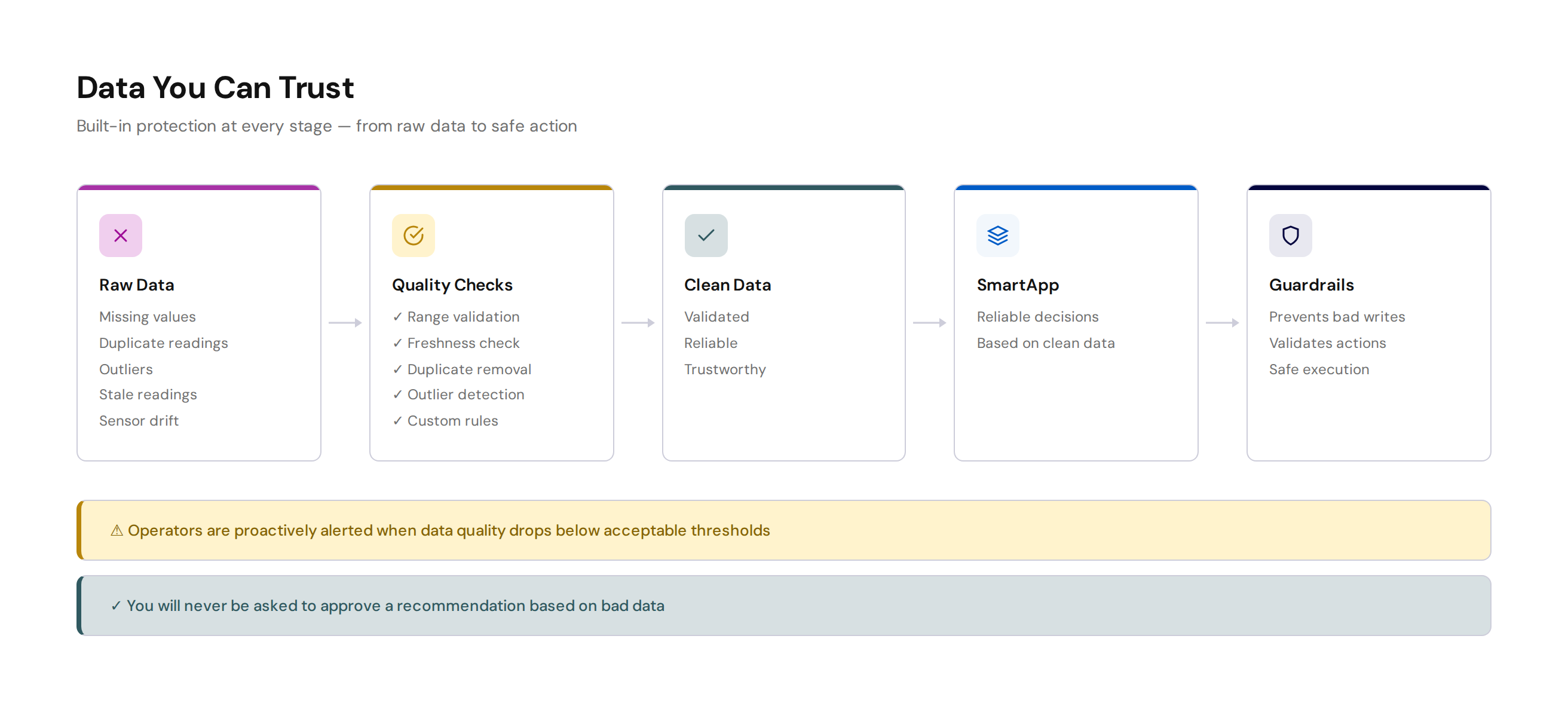
What Kelvin monitors automatically:
- Missing or stale data
- Duplicate readings
- Values outside expected ranges
- Sensor drift and outliers
What Kelvin prevents:
- Bad data influencing automated decisions
- Erroneous setpoints being written to your assets
- Actions taken without sufficient data quality
What operations teams see:
- Proactive alerts when data quality drops below acceptable thresholds
- Clear indicators of which assets and streams are affected
- Confidence that when Kelvin recommends an action, the data behind it is sound
For Operations
You will never be asked to approve a recommendation based on bad data. The platform catches it before it reaches you.
The ROI Picture
Kelvin creates measurable value. How that value shows up depends on where you sit.
If You Run Operations
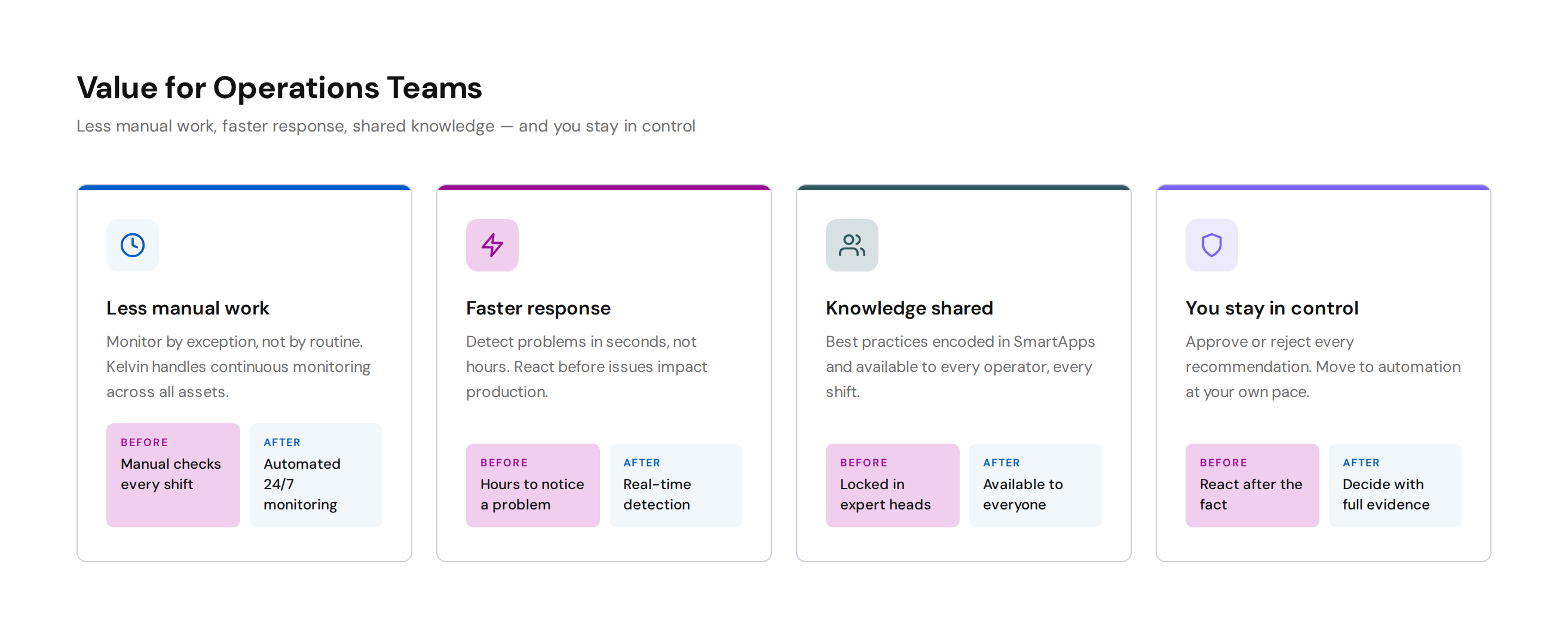
| Before | After |
|---|---|
| Manual monitoring across shifts | Automated monitoring, act by exception |
| Slow reaction to problems | Real-time detection and response |
| Knowledge locked in experienced heads | Knowledge encoded in SmartApps, available to everyone |
| One problem, one fix, one asset | One fix deployed across the entire fleet |
If You Manage the Business
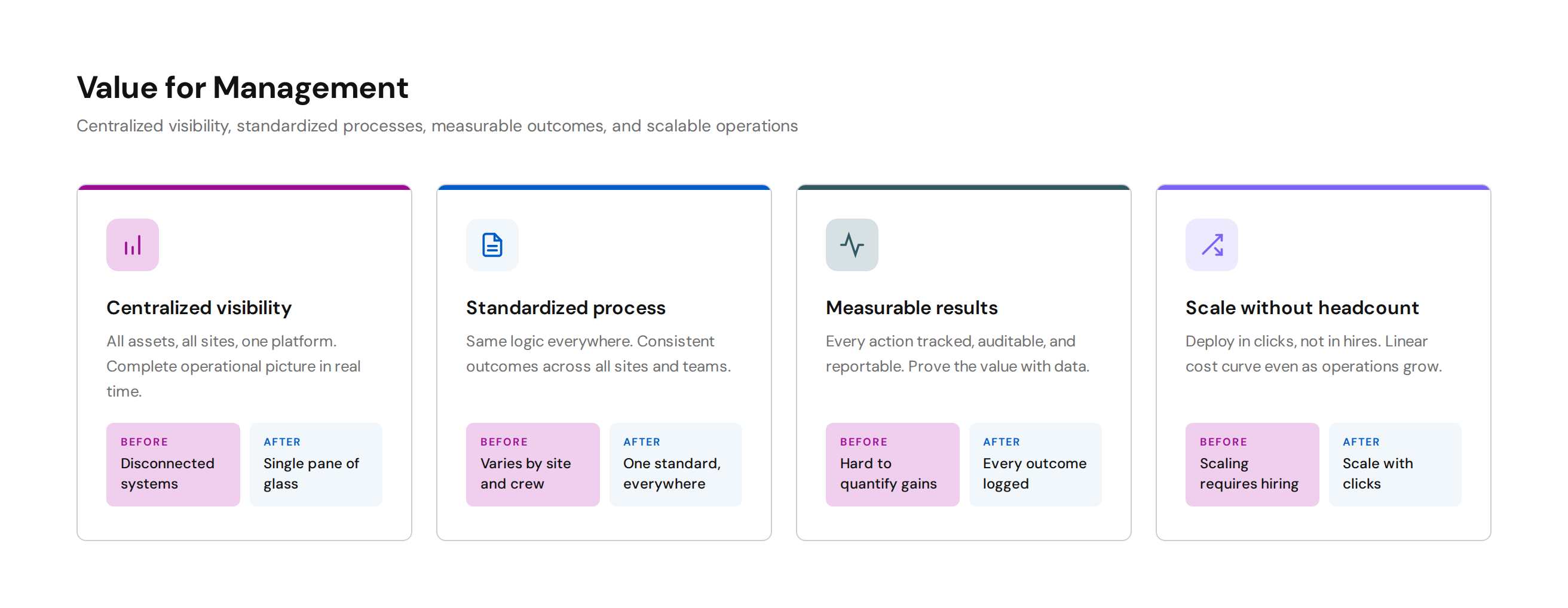
| Before | After |
|---|---|
| Disconnected systems, incomplete picture | Centralized visibility across all assets |
| Inconsistent processes across sites | Standardized workflows, same logic everywhere |
| Difficult to quantify operational improvements | Every action tracked, auditable, measurable |
| Scaling requires headcount | Scaling requires clicks |
If You Are Evaluating the Investment
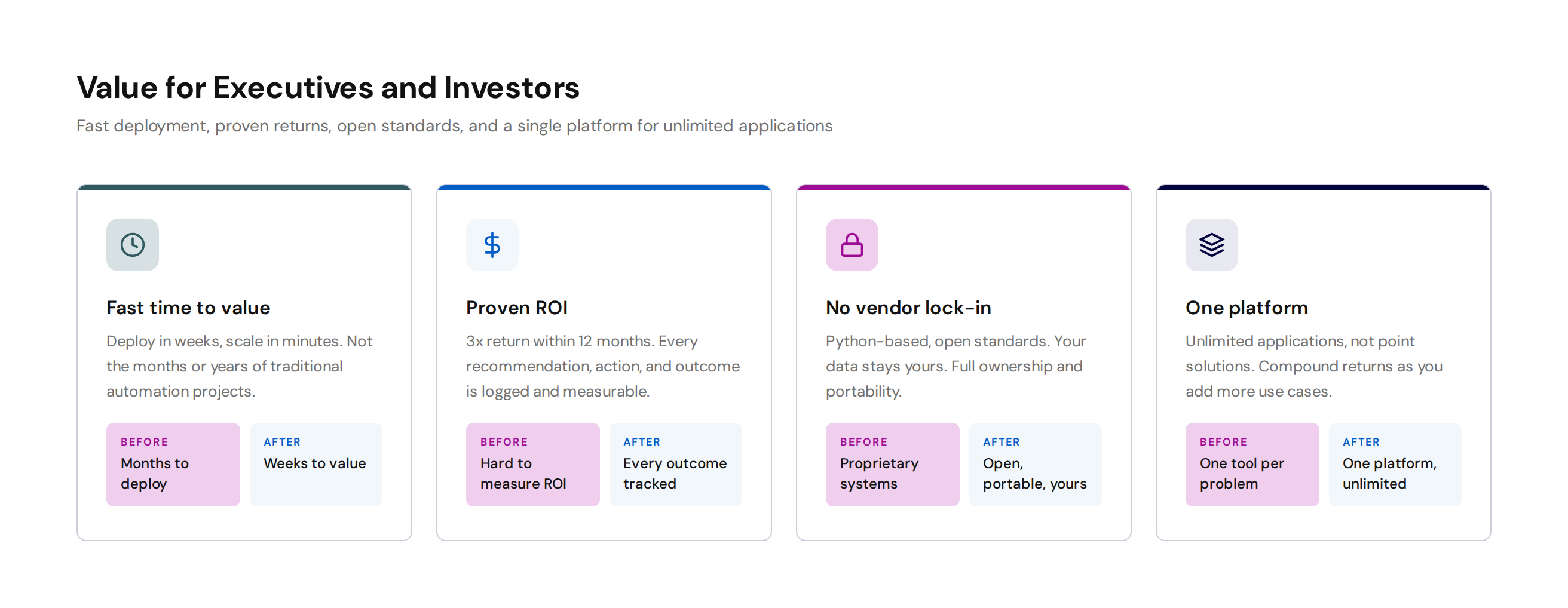
| Before | After |
|---|---|
| Automation projects are expensive, slow, risky | Kelvin deploys in weeks, scales in minutes |
| ROI is hard to measure | Every recommendation, action, and outcome is logged |
| Vendor lock-in to proprietary systems | Python-based, open standards, your data stays yours |
| Point solutions for each problem | One platform, unlimited applications |
Key Insight
Kelvin customers have achieved 3x ROI within 12 months. The platform pays for itself — and then keeps paying.
What Could You Build?
Here are just a few ideas across different industries. The pattern is always the same — connect your data, add intelligence, take action, scale it.
- Well production optimization (beam pump, PCP, gas lift, ESP)
- Plunger lift automation and non-arrival response
- Compressor fleet optimization
- Flare management and emissions tracking
- Predictive failure detection across rotating equipment
- Moisture and quality control for dryers, kilns, ovens
- Multi-objective process optimization (quality + energy + throughput)
- Predictive maintenance on motors, pumps, conveyors
- Batch process optimization and recipe management
- Energy cost reduction through demand-based scheduling
- Grid load balancing and demand response
- Renewable generation forecasting and integration
- Substation monitoring and automated switching
- Water treatment process optimization
- HVAC and building energy management
- Vehicle and equipment tracking across dispatch systems
- ERP integration for crew and asset scheduling
- Material and inventory tracking through the supply chain
- Route optimization using real-time conditions
- Maintenance scheduling based on actual equipment usage
- Crusher and mill optimization
- Haul truck fleet management and fuel optimization
- Conveyor health monitoring
- Tailings and environmental compliance monitoring
- Ventilation control in underground operations
Summary
By now you should have a good sense of what Kelvin can do — and more importantly, what it could do for you.
The power is in the combination: smarter control on your existing systems, the ability to scale solutions across your entire operation, enterprise-wide connectivity, and data quality you can trust.
Whether you are an operator looking for less manual work, a manager looking for centralized control, or a decision-maker looking for measurable returns — the starting point is the same.
Pick one problem. Solve it. Scale it.
From here, continue to the relevant areas of the Kelvin Academy to go deeper into the topics that matter most to you.
Good luck and Happy Learning !
Test Your Knowledge
1. Does Kelvin replace your existing PLCs, DCS, or RTUs?
Answer: No. Kelvin sits above your existing control systems as an intelligence layer. It does not replace them — it makes them smarter by adding ML-driven insights and higher-level coordination on top.
2. What is the \"Human in the Middle\" concept?
Answer: Every recommendation Kelvin generates can be configured to require manual approval before any action is taken. This keeps Operations teams in control. As trust builds, workflows can move from manual approval to fully automatic — at the operator's pace.
3. How can a SmartApp built for one asset be applied to thousands?
Answer: Once a SmartApp is built and uploaded to the App Registry, it can be deployed to any number of assets with a few clicks. No reinstallation, no per-site reconfiguration. The platform handles distribution, monitoring, and management.
4. In the industrial dryer example, what problem did Kelvin solve?
Answer: Operators were manually monitoring and adjusting controls throughout the shift, leading to fluctuating moisture quality. Kelvin used a machine learning model to predict moisture trends and automatically adjust setpoints through the existing control system, making output quality consistent across all shifts.
5. What is \"per-asset tuning\" and why does it matter?
Answer: Each asset can have its own parameter configuration within the same SmartApp. One dryer may need different thresholds than another. Kelvin handles this without needing a separate application per asset.
6. What kind of external systems can Kelvin connect to?
Answer: Kelvin can connect to ERP/SAP (automated work orders, material tracking), MES (production data, quality metrics), analytics platforms (Databricks, BigQuery), communication tools (Email, Slack), and any system with a REST or MQTT interface.
7. What does Kelvin do to protect against bad data influencing decisions?
Answer: Kelvin automatically monitors for missing/stale data, duplicates, out-of-range values, and sensor drift. It prevents bad data from influencing automated decisions and prevents erroneous setpoints from being written to assets. Operators are proactively alerted when data quality drops.
8. What is the ROI for Operations teams when using Kelvin?
Answer: Manual monitoring is replaced by automated monitoring where operators act by exception. Reaction to problems becomes real-time. Experienced knowledge is encoded into SmartApps and available to everyone. A fix deployed once applies across the entire fleet.
How Did You Do?
| Score | Level |
|---|---|
| 8/8 | Ready to move to the next course |
| 6–7 | Good foundation — review the sections you missed |
| Below 6 | Read through the course again before moving on |
Next Steps
Move on to 103 — Kelvin UI Guided Tour to understand how each role interacts with the platform.